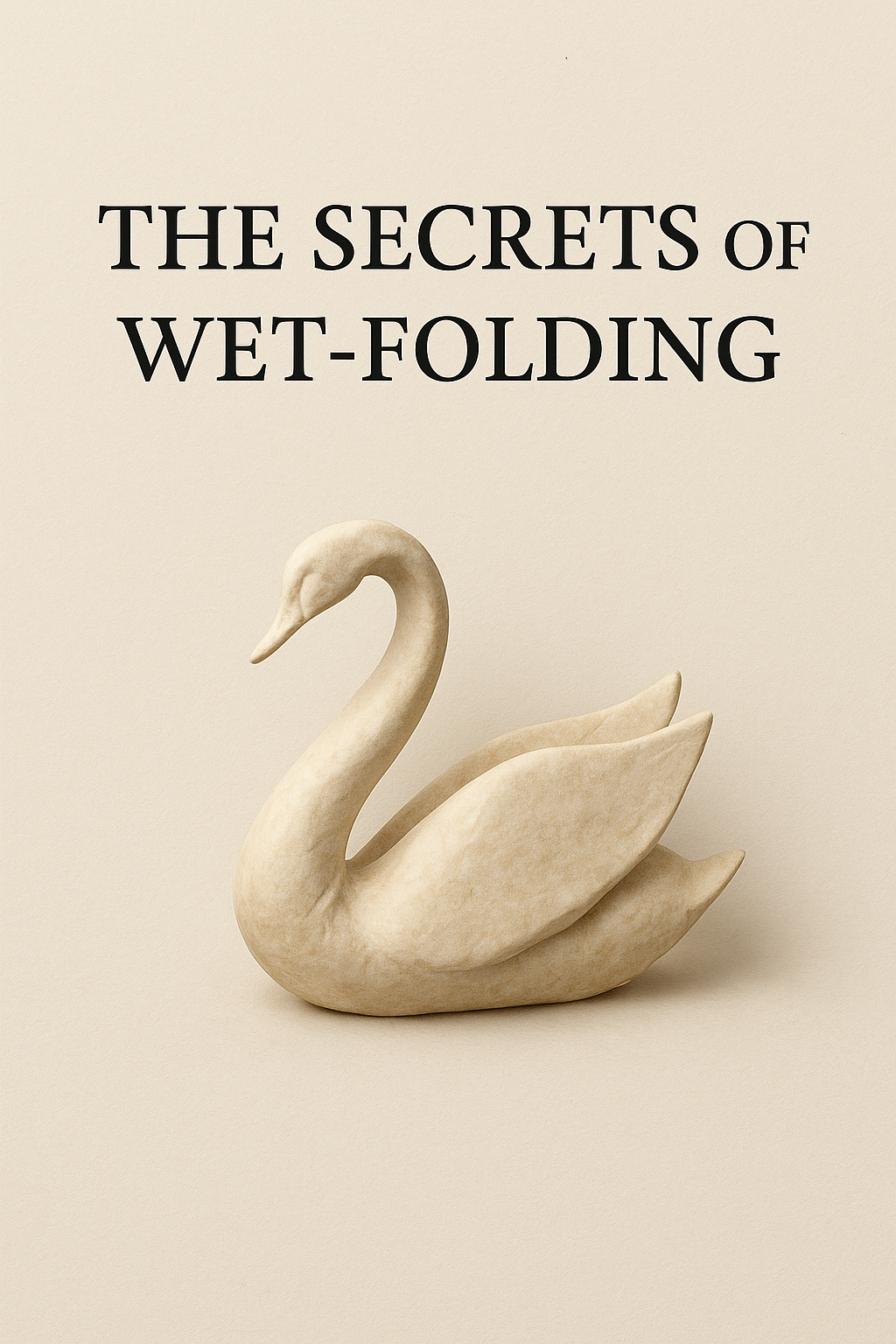
The Secrets of Wet-Folding
Ready to turn your paper models into rigid, lifelike sculptures? Welcome to the artistic technique of wet-folding.
Wet-folding is an advanced technique, popularized by master Akira Yoshizawa, that allows you to sculpt paper as if it were clay. By using a small amount of moisture, you make the paper pliable, allowing you to create soft curves and rounded forms instead of just sharp creases. When the paper dries, it becomes incredibly stiff, holding its new shape permanently. This is the secret to creating hyper-realistic animals and organic shapes.
What You’ll Need
- Thick paper: Regular kami paper will tear. Use watercolor paper, elephant hide, or thick art paper.
- A simple folded model: It’s best to practice on a simple animal you’ve already folded.
- A sponge and small bowl of water.
Learning to Wet-Fold in 5 Steps
Step 1: Choose and Prepare Your Paper
The most important step is your paper. It must be thick and strong, with long fibers that won’t tear when wet. Cut your watercolor or art paper into a perfect square. Regular, thin origami paper will simply fall apart.

Step 2: Fold a Simple Base Model
Before you can sculpt, you need a basic shape. Fold a simple model, like a bird base or a basic animal (e.g., a simple bear or dog). Don’t crease the folds too hard yet; just make them soft and gentle. You’ll be shaping these folds, not just flattening them.

Step 3: Dampen the Paper (Don’t Soak!)
This is the critical step. Squeeze your sponge so it’s just damp, not dripping. Gently wipe both sides of the paper. You want the paper to be cool and pliable, but NOT wet or shiny. If you use a spray bottle, spray from a distance and immediately blot excess water. Wait a minute for the water to soak in.

Step 4: Sculpt Your Model
While the paper is damp and flexible, work quickly! Instead of just creasing, gently pinch and roll the paper. Round the back of your animal model. Give the legs a curved, muscular shape. Pinch the ears to make them thinner and more realistic. The paper will hold these curves as it dries.

Step 5: Let It Dry Completely
This is the easiest, yet hardest, step: do nothing! Position your sculpted model exactly how you want it to look and leave it alone to dry. This can take several hours or even overnight. As it dries, the paper fibers will lock into place, making your model rigid and permanent. Do not try to speed it up with a hairdryer, as this can warp the paper.

Congratulations! You’ve just learned the fundamental secret behind many of the most breathtaking origami sculptures. This technique takes practice, so be patient. Start with simple models and experiment with different paper types to see what works best for you. Happy sculpting!
Explore More Projects
The Sonobe Unit
Learn the building block for amazing 3D geometric models.
Paper Fortune Teller
A classic origami game you can fold and play in minutes.
Origami Unicorn Head
Fold a simple and magical unicorn from a fairy tale.
Jumping Paper Frog
An interactive classic that can really leap across the table!