Dollar Bill Origami Heart — Step-by-Step Money Folding Guide
Updated
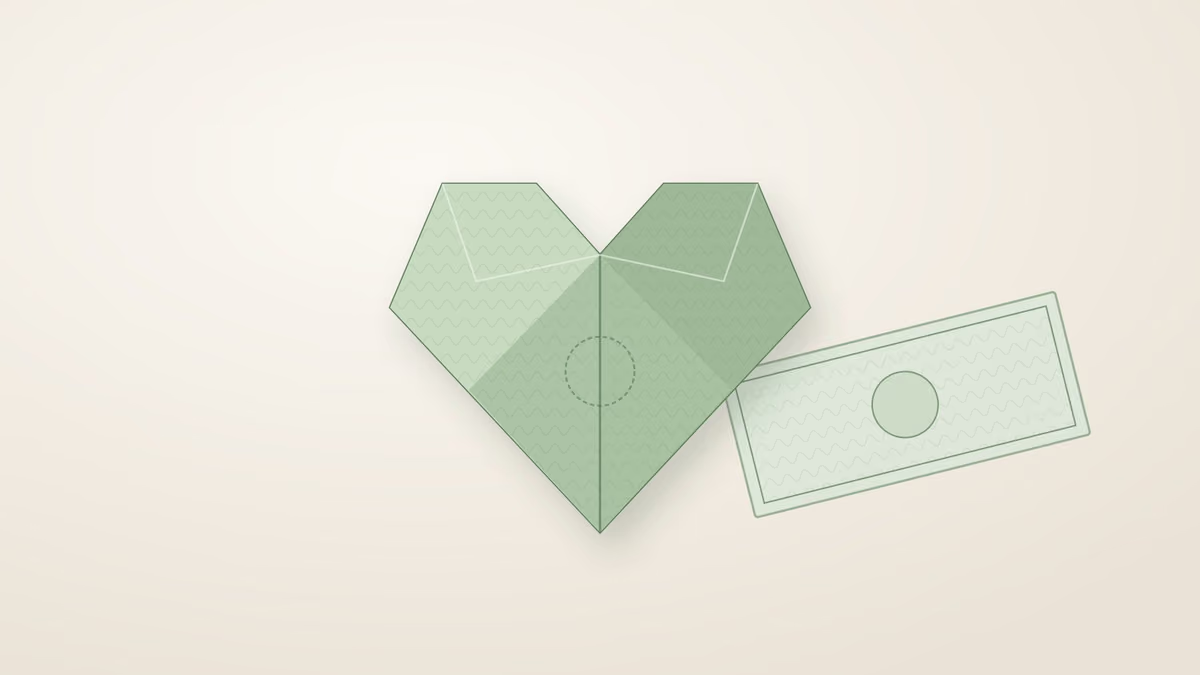
This dollar bill origami heart guide walks you through folding a crisp, seamless 44 × 39 mm money heart from one uncut US banknote (2.61 × 6.14 in / 66 × 156 mm) in 10 exact steps. By folding lengthwise into thirds, bringing both short ends to the center crease, lifting the halves at 45° into a V-shape, and rounding the corners on the back, you get a clean gift or restaurant tip with zero raw edges showing. Check the currency compatibility table below for EUR, GBP, JPY, and CAD adjustments.
Currency Size & Aspect-Ratio Compatibility Table
US currency has a long 2.35:1 proportion that lets both short ends meet flush at the center crease. Shorter international bills fold just as cleanly with one small adjustment in Step 3.
| Currency | Bill Dimensions | Aspect Ratio | Material & Crease Feel | Step 3 Short-End Adjustment |
|---|---|---|---|---|
| USD ($1, $5, $20, all bills) | 66.3 × 156.0 mm (2.61 × 6.14 in) | 2.35 : 1 | Cotton-linen rag — holds sharp creases easily | Exact fit: fold both short ends flush to the vertical center crease |
| CAD ($5, $10, $20) | 69.9 × 152.4 mm (2.75 × 6.00 in) | 2.18 : 1 | Polymer — springs back slightly; press with a coin | Fold each short end ~2 mm shy of the center crease for balanced lobes |
| JPY (¥1,000 / ¥10,000) | 76 × 150 mm / 76 × 160 mm | 1.97 : 1 / 2.11 : 1 | Mitsumata cotton-blend — superb crisp folds | On ¥1,000 leave a ~4 mm gap each side of center; on ¥10,000 fold nearly flush |
| GBP (£5 / £10 / £20) | 65 × 125 mm to 73 × 139 mm | 1.90–1.92 : 1 | Polymer — score creases gently with a fingernail or coin | Stop each short end ~5–6 mm before the center crease so upper lobes stay tall |
| EUR (€5 / €10 / €20) | 62 × 120 mm to 72 × 133 mm | 1.85–1.94 : 1 | Pure cotton fiber — folds cleanly without cracking | Stop each short end ~6 mm before the center crease (leaving a ~12 mm center gap) |
10-Step Classic Dollar Bill Origami Heart Instructions
Calibrated for US currency (66 × 156 mm). Every fold uses exact edge landmarks so both halves stay symmetrical without measuring.
Classic US Dollar Bill Heart (10 Steps)
Turns one uncut US bill into a compact 44 × 39 mm heart with hidden short ends, clean folded lobe tops, and a smooth display face.
Materials: One crisp US dollar bill ($1, $5, $10, or $20 — 2.61 × 6.14 in / 66 × 156 mm) · Optional: flat coin or bone folder for ultra-sharp creases (5 min)
Step 1: Fold the bill lengthwise into equal thirds
Place the US bill horizontally on a flat table with the portrait side facing down. Fold the bottom third straight upward and the top third straight downward so all three layers align neatly into a long 156 × 22 mm strip.
Crease tip: Roll the bill gently into an S-curve first to line up both long edges cleanly before flattening the two creases.
Step 2: Mark the exact vertical centerline
Fold the long horizontal strip in half from left short end to right short end, match both short edges flush, crease sharply along the center, and unfold back into the long strip.
Crease tip: Keep the two folded-over long layers facing up so your next fold locks them cleanly inside.
Step 3: Fold both short ends inward to the center crease
Bring the left short end inward to meet the vertical center crease, then bring the right short end inward to meet the same centerline, creating a compact 78 × 22 mm rectangle.
Crease tip: Leave a 0.5 mm hairline gap between the two ends at the center crease so the 45° diagonal folds bend without bunching.
Step 4: Fold the left half upward at 45° from the center
Pin the bottom center crease with one fingertip and valley-fold the entire left half straight upward at a crisp 45° angle so its bottom edge aligns flush along the vertical centerline.
Crease tip: The folded short end stays hidden inside this diagonal fold, turning the outer folded edge into a smooth heart lobe top.
Step 5: Fold the right half upward at 45° to form the V-shape
Mirror Step 4 on the right side: valley-fold the right half upward at 45° from the bottom center crease so its inner edge kisses the left lobe along the center line, forming a crisp V-shaped heart silhouette.
Crease tip: Check that the bottom V-point comes to a clean 90° corner and both upper lobes reach the exact same height (about 39 mm).
Step 6: Flip the heart over to the back side
Turn the entire model over from left to right so the smooth, unbroken heart front rests face-down against the table and the layered seams face you.
Crease tip: All corner-rounding folds happen on this back face so the finished front stays completely clean and seamless.
Step 7: Round the outer upper corners of both lobes
Valley-fold the top-left outer corner diagonally inward and downward by roughly 6–7 mm (about one-third of that lobe’s width). Mirror the exact same small triangle fold on the top-right outer corner.
Crease tip: Press each small corner firmly with a thumbnail or coin edge—the layered cotton bill holds tiny folds tightly once set.
Step 8: Shape the top center heart cleft
Valley-fold the two inner top corners (touching at the center split) diagonally outward and downward by roughly 6–7 mm each, creating a crisp symmetrical V-notch between the two lobes.
Crease tip: Match the depth of your inner and outer top corner folds so both lobes look evenly rounded rather than boxy.
Step 9: Soften the sharp outer side points
Make one tiny 2–3 mm vertical valley fold on the far-left outer side point and one matching 2–3 mm fold on the far-right outer side point to taper the widest corners into a smooth heart curve.
Crease tip: Keep these side folds narrow—just enough to take off the sharpest point without shrinking the heart’s width.
Step 10: Flip right-side up and press flat
Turn the finished heart back over to its smooth display side and press firmly across all edges with a thumb pad or flat coin so the 44 × 39 mm dollar bill heart lies flat and ready to gift.
Money-Folding Etiquette & Gifting Tips
A folded money heart turns an ordinary tip, graduation check, or wedding card into a memorable handmade keepsake.
Never use tape, glue, or staples on currency
Keep the bill 100% spendable and undamaged. Crisp creases lock naturally on cotton-linen US bills with zero adhesive; if mailing inside a card, tuck the heart into a small glassine sleeve or paper slit.
Ask a bank teller for crisp sequential bills
Soft, worn bills from a pocket still fold, but fresh uncirculated bills from a bank counter produce razor-sharp 45° edges and hold tiny corner-rounding folds flat for weeks.
Display ideas for weddings, tips & birthdays
Slip a $5 or $20 heart onto a coffee-cup saucer for a barista, arrange five $1 hearts in a star ring inside a graduation card, or pair a $20 heart with a handmade origami envelope.
- Pair a Dollar Bill Heart with a Dollar Bill Shirt for a fun wedding-couple cash gift.
- Practice once with a 66 × 156 mm scrap paper strip before folding a crisp $20 or $100 bill.
Showing the denomination number cleanly
If you prefer the green back lettering to show across the front of the heart, start Step 1 with the portrait side facing UP instead of down—the exact same 10 steps work identically either way.
More Heart & Gift Tutorials to Pair With It
Want a matching handmade card envelope or a larger paper heart alongside your money fold? Try these illustrated step-card tutorials.


Frequently Asked Questions
Is it legal to fold dollar bills into origami hearts?
Yes. Folding currency into origami hearts or shirts for tips and gifts is completely legal in the United States as long as you do not cut, tear, burn, glue, or deface the bill so it remains fit to be unfolded and spent.
What size is a finished US dollar bill origami heart?
Using the lengthwise-thirds method on a standard US bill (66.3 × 156 mm), the finished heart measures approximately 44 mm wide by 39 mm tall (about 1.7 × 1.5 inches)—an ideal compact heart proportion.
Can I fold a dollar bill heart using Canadian, Euro, or British bills?
Yes. Canadian polymer bills are close to US proportions (leave a 2 mm gap at center and press creases with a coin). Shorter Euro, British, and ¥1,000 bills fold cleanly when you stop each short end 4–6 mm before the center crease in Step 3 so the upper lobes keep full height.
Why do the top corners of my dollar bill heart pop back up?
Six-layer corners on thick or polymer bills need extra firm setting. Pin the folded corner down on a hard table and burnish the crease twice with the smooth flat edge of a coin or bone folder.
Should I use a new bill or an old bill for money origami?
A crisp, newer bill with few prior wrinkles always gives cleaner edges and holds the rounded corners flat. Very soft, heavily circulated bills work best for quick practice rather than formal gifts.
How do I practice a dollar bill heart without wrinkling real cash?
Cut regular 80 gsm copy paper to 66 × 156 mm (2.61 × 6.14 inches) so your practice sheet matches US currency proportions millimeter for millimeter.